There is a moment in the cyanotype process that never gets old for me.
The plant is laid carefully onto the treated paper. The frame is carried outside into the light. And then you wait — watching as the paper slowly shifts from a pale, silvery coating to a deep, rich blue right before your eyes. When you rinse the print in water and the image appears fully for the first time, it feels a little like magic every single time. Learn what is a cyanotype in this post.
What Is a Cyanotype?
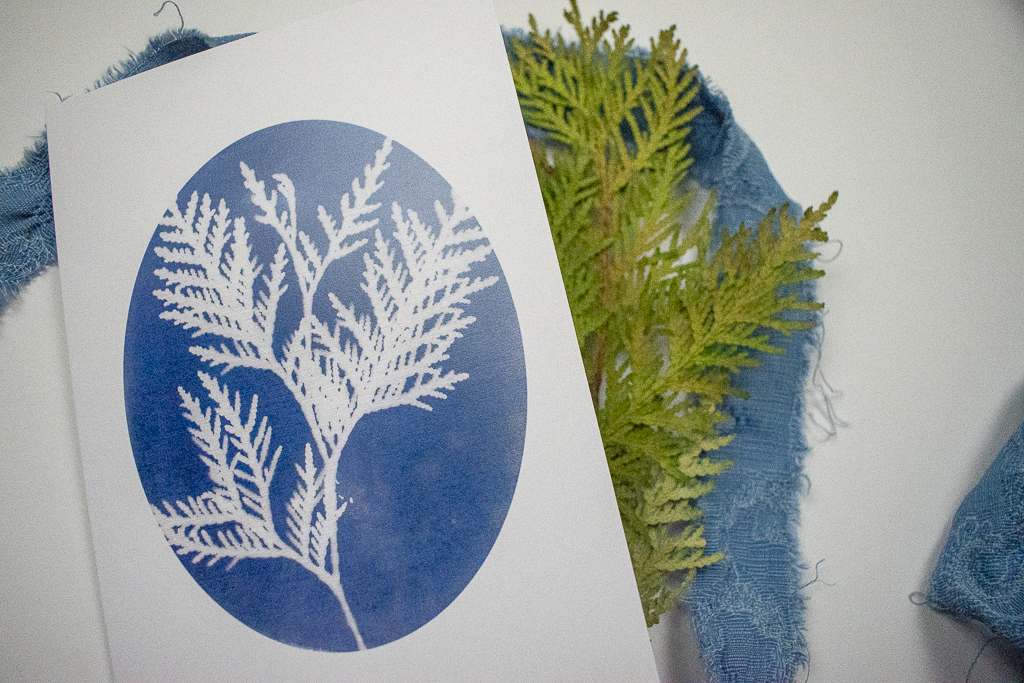
The Ancient Art Process Behind Your Favourite Blue Prints
But it is not magic. It is chemistry — and it is a process that has been used by artists, scientists, and photographers for nearly two hundred years.
Become an art collector for early access and special rewards!
The History of Cyanotype
The cyanotype process was invented in 1842 by the English scientist and astronomer Sir John Herschel. He was searching for a way to reproduce his notes and diagrams — a kind of early photocopying — and what he discovered was a light-sensitive chemical process that produced a vivid Prussian blue print wherever it was exposed to ultraviolet light.
Not long after, the botanist Anna Atkins became the first person to use the process artistically. She created a series of cyanotype prints of algae and botanical specimens that are now considered the first photographically illustrated books ever produced. Her work is extraordinary — delicate, precise, and deeply beautiful. She understood something that artists still understand today: that the cyanotype process has a particular affinity for the natural world.
The word cyanotype comes from the Greek word for blue — and that characteristic deep Prussian blue is the defining quality of every print made using this process.
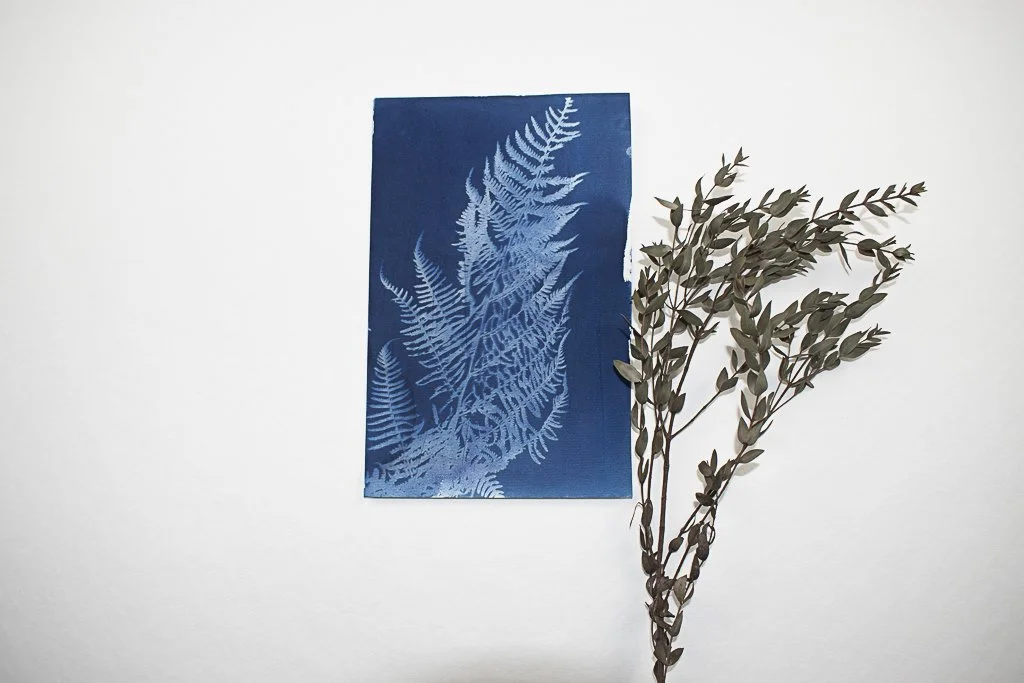
How a Cyanotype Is Made
The process begins with two chemicals — ferric ammonium citrate and potassium ferricyanide — mixed together to create a light-sensitive solution. This solution is coated onto paper or fabric and left to dry in the dark.
Once the coated paper is dry, objects are placed directly onto the surface. In my work, I use real botanicals — pressed leaves, flowers, branches, and grasses gathered from the natural world around me. The paper is then exposed to direct sunlight, which is where the chemistry happens.
Wherever the sunlight reaches the treated paper, the chemicals react and the paper turns that deep, characteristic blue. Wherever the botanical is resting — blocking the light — the paper remains pale and unexposed. When the print is rinsed in clean water, the unexposed areas wash away to white, and the blue deepens and intensifies as it dries.
What you are left with is a silhouette — the ghost of a real plant, captured in light and chemistry on paper. Every piece is completely unique because no two plants are identical, no two days of sunlight are the same, and the process itself carries a beautiful unpredictability that no digital process can replicate.
Learn more about how to make a cyanotype here!
Why Every Cyanotype Is One of a Kind
This is something I want every person who owns one of my cyanotypes to understand and appreciate: there is no print run. There is no edition. There is no digital file being sent to a printer somewhere.
Each piece begins with a real plant that I have gathered, pressed, and chosen for the way its shape will read against the blue. Each piece is exposed in real sunlight — which means the season, the time of day, the cloud cover, and the temperature all play a role in the final result. Each piece is rinsed, dried, and examined by hand.
Two cyanotypes made from the same plant on the same day will still look different from one another. That is the nature of the process, and it is one of the things I love most about it.
When you bring a cyanotype into your home, you are bringing in a piece that is genuinely irreplaceable. It cannot be reordered. It cannot be reproduced. It is the only one of its kind in the world.
The Feeling a Cyanotype Brings to a Space
People often tell me that there is something calming about cyanotype art. I think it comes from the combination of the deep, cool blue — one of the most universally soothing colours — and the organic, natural quality of the botanical shapes. There is nothing harsh or industrial about a cyanotype. It is quiet. It is rooted in the natural world. It brings something of the outdoors inside.
In a bedroom, a cyanotype on the wall feels restful and still. In a kitchen or dining room, a botanical print brings a sense of the garden indoors. In an entryway, it is the first thing you and your guests see — and it says something about who you are and what you value before a single word is spoken.
Small cyanotypes work beautifully in frames on a windowsill or bookshelf. Larger pieces make a statement on a feature wall. A grouping of several prints at different sizes creates a gallery that feels like a collected, personal display rather than a decorated wall.
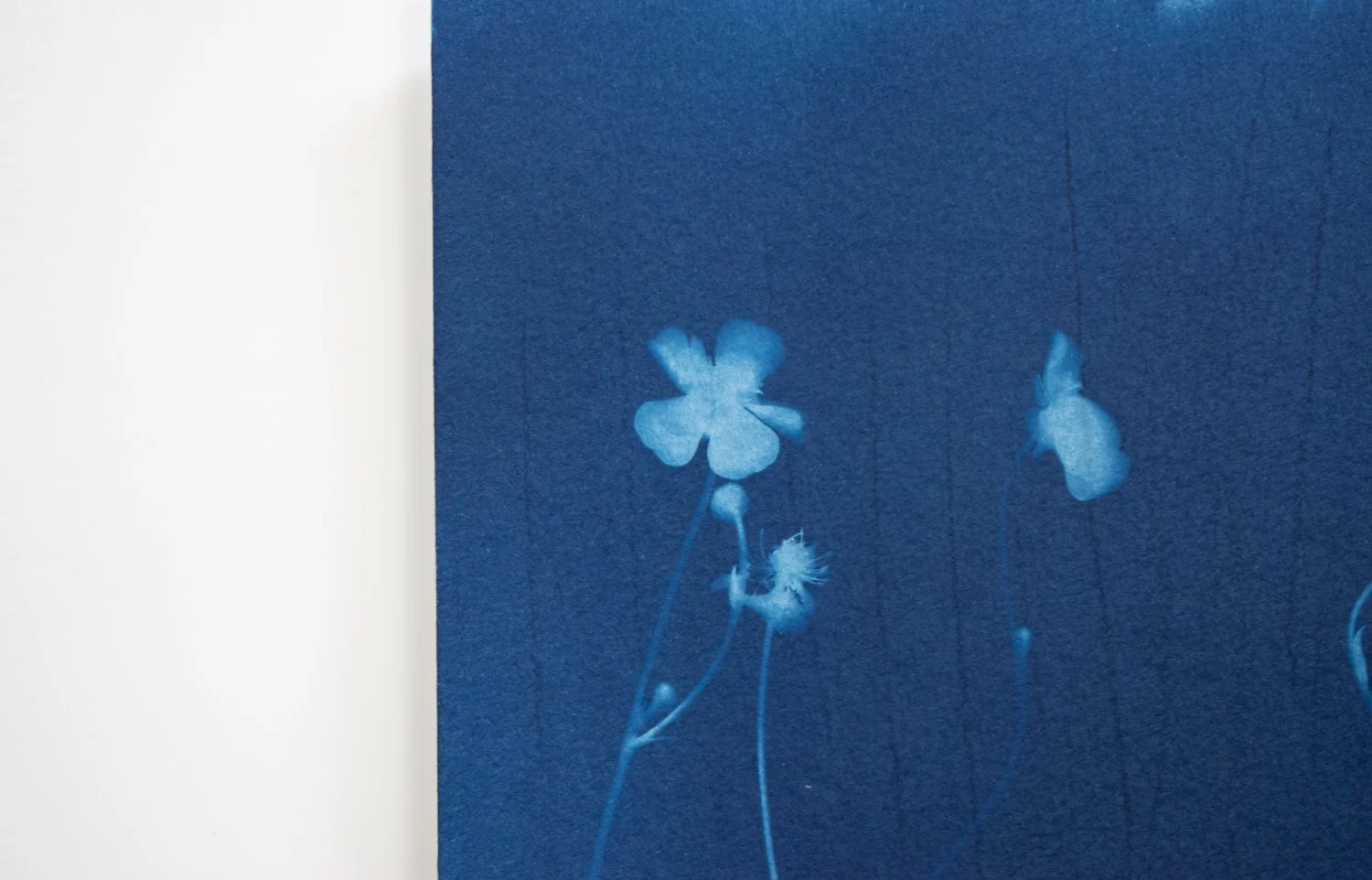
My Cyanotype Work
My cyanotypes are inspired by the plants and botanicals I find in the natural world around me — some cultivated in my own garden, some gathered on walks, some pressed carefully from seasonal flowers before they fade.
I offer original cyanotype pieces in 5x7 and 8x10 inches, as well as custom commissions where you can choose the botanical and add personalized text — a name, initials, or a short word — to make the piece entirely your own. Each original comes with a Certificate of Authenticity, because a one-of-a-kind piece deserves to be recognised as such.
If you have questions about a specific piece or would like to discuss a commission, I would love to hear from you. You can reach me through the contact form below.